What is Dark Money?
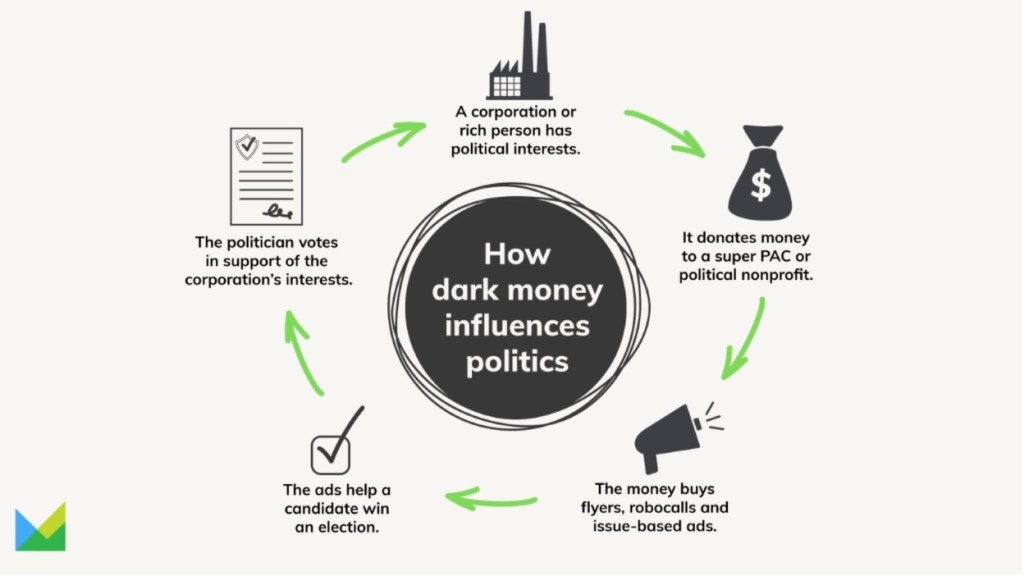
In United States politics, dark money, sometimes called secret money, refers to elections influenced by spending. The source of the funds remains disclosed to the voters. Some types of nonprofit organizations may spend money on election campaigns without revealing who their donors are. The most common type of dark money group is the 501(c)(4), often called social welfare organizations. These organizations can receive unlimited donations from corporations, individuals, and unions. Proponents of dark money maintain it is protected under the First Amendment, while critics complain recipients of dark money “knows exactly who he owes a favor.” However, voters remain in the dark about connections between donors and politicians when favors are paid back.
~~~ https://en.wikipedia.org/wiki/Dark_money
Dark money groups have poured billions of dollars trying to influence federal elections — mainly on television and online ads and mailers — since the Supreme Court’s Citizens United v. FEC decision on Jan. 21, 2010, which gave rise to politically active nonprofits. This ruling established the First Amendment rights of corporations, including nonprofits. The U.S. Supreme Court determined that corporations may be engaged in political speech like TV ads or mailers and not prohibited from doing so. After that, elections became increasingly expensive and less transparent.
~~~ https://www.opensecrets.org/news/2023/01/dark-money-groups-have-poured-billions-into-federal-elections-since-the-supreme-courts-2010-citizens-united-decision/
Following Citizens United, many states controlled by Republican and Democratic politicians passed stricter campaign finance disclosure rules, so everyone knows who is trying to influence their votes. Unfortunately, Ohio was not one of them.
https://www.commoncause.org/ohio/democracy-wire/what-is-dark-money-how-did-we-get-here-how-can-we-finally-fix-this-problem/

 Info in Bits & Pieces
Leave a comment